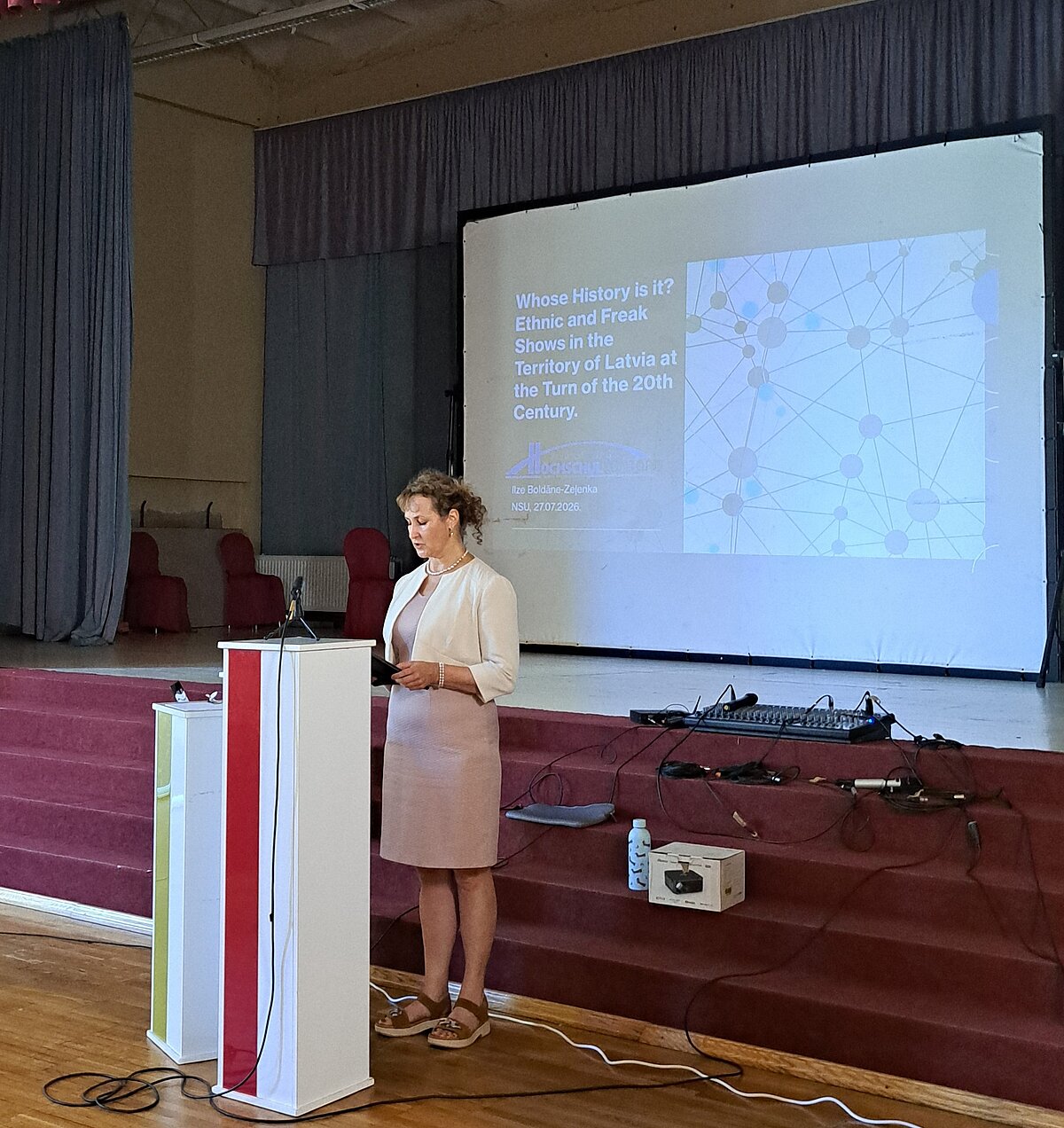
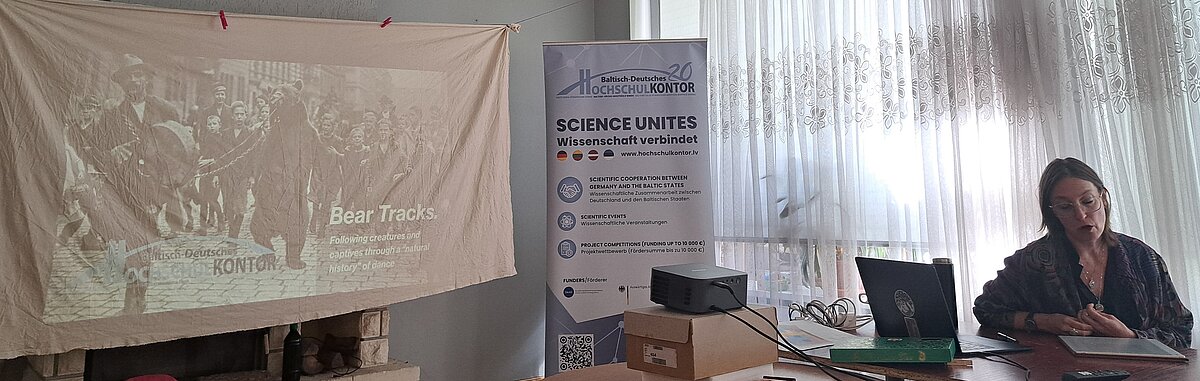
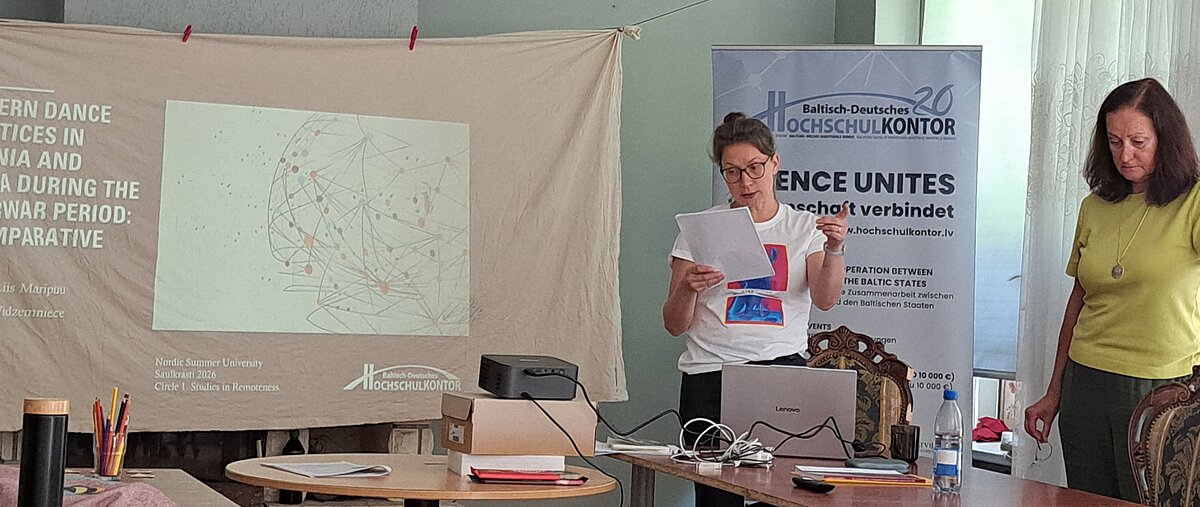
Scholars from Estonia, Latvia, Lithuania, and Germany took part in the thematic stream "Studies in Remoteness: Sensoria of Absence, Distance and Neglect," one of ten streams at the summer school. Their participation was supported by the project "Shared Stages, Entangled Pasts: Performance Research Across the Baltic–German Region," funded by the Baltic-German University Liaison Office. During the event, these researchers presented on the history of performing arts, anthropology, and cultural exchange in the Baltic-German region.
Lindsey Drury (Free University of Berlin) used the example of a Bärenfell (bearskin) dance regalia, taken from the Mamalilikulla nation (in present-day British Columbia) by nineteenth-century Norwegian sailor and living-exhibition promoter Johan Adrian Jacobsen, to illustrate how colonial anthropology separated the "natural" from the "cultural." Drury argued that colonial anthropology not only distinguished these categories but also produced them as mutually constitutive, shaping the understanding of both Indigenous ceremonial practices and European national traditions.
Andrea Zittlau (University of Rostock) examined the life of Nayo Bruce, a descendant of a "Dahomey Amazons" troupe member, tracing his journey from childhood in Togo to guardianship under the German von Fircks family. Zittlau focused on the early twentieth-century practice of adopting African children and reviewed current methodologies for identifying and researching such cases, including Erin Manning’s anarchive, experimental archaeology by Sam Kean, and the literary imagination of Saidiya Hartman.
Vida Savoniakaitė (Lithuanian Institute of History) presented on entangled pasts in the Baltic-German region, highlighting connections between the Baltic-German academic community and the ethnographic, anthropological, and philosophical theories of the time. She also demonstrated how Eduards Volter’s (1856–1941) work for the Russian Empire aligned with the political objectives of Latvians and Lithuanians during that period.
Independent researcher Anne-Liis Maripuu and Valda Vidzemniece (Jāzeps Vītols Latvian Academy of Music) explored the mutual influences among Germans, Latvians, and Estonians on the development of modern dance in the early twentieth century. They also analyzed how the changing political climate of the 1930s affected artistic exchanges and how modern dance became linked to national identity in Latvia and Estonia.
This project of the Baltic-German University Liaison Office is supported by the German Academic Exchange Service (DAAD) with funds from the Foreign Office of the Federal Republic Germany.