
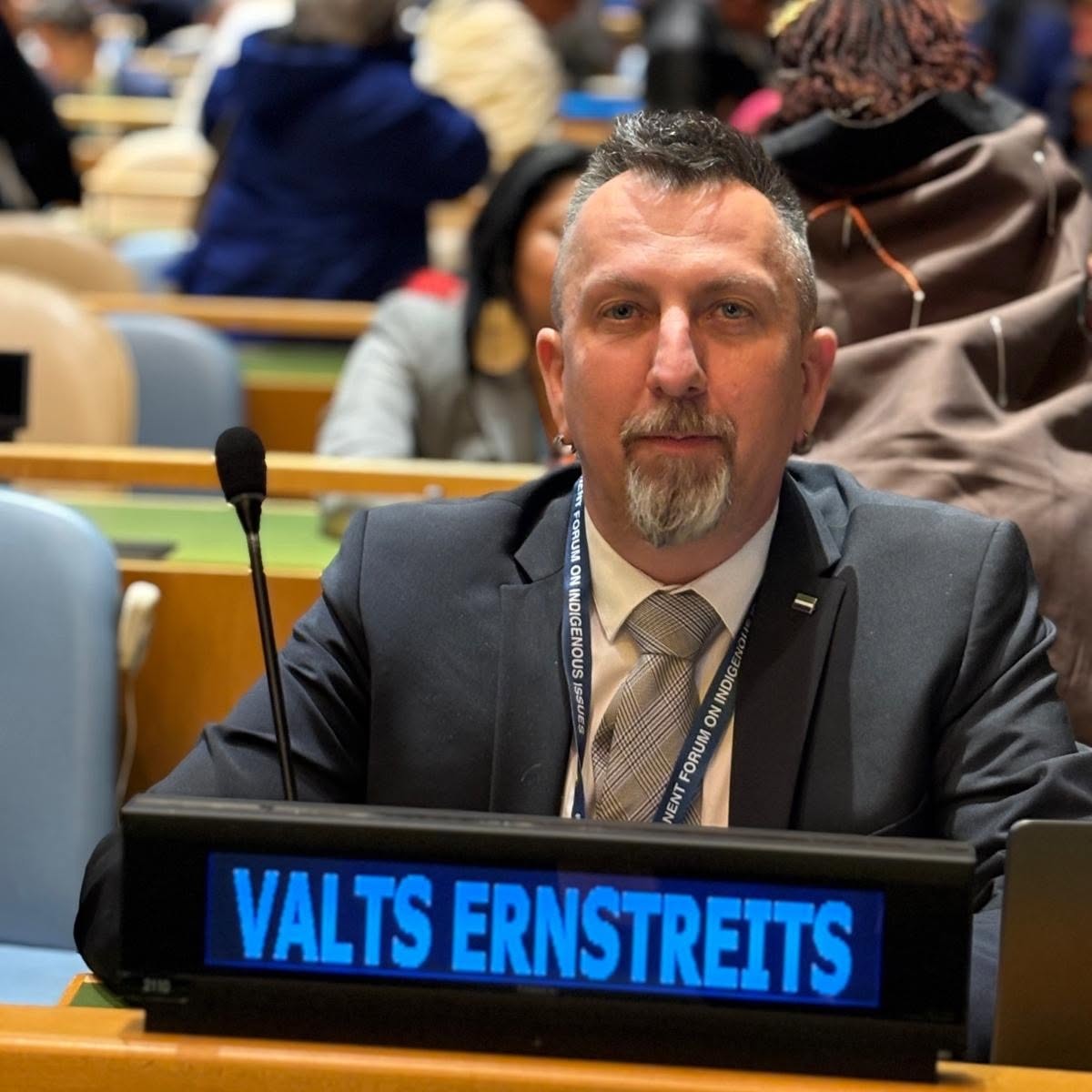
From 21 to 29 April 2025, the Director of the Livonian Institute at the Faculty of Humanities, University of Latvia, Valsts Ernštreits, represented Latvia for the first time at the twenty-fourth session of the United Nations Permanent Forum on Indigenous Issues (UNPFII) taking place in the UN Headquarters in New York, the United States. He introduced the participants of the session with issues related to the Livonians (Livs), the organisation of indigenous peoples, and new global policy initiatives in the field of language technologies, including the Global Roadmap for Multilingualism in the Digital Era currently being developed by UNESCO.[1]
During the 25th session of the UNPFII, which was held in New York (USA) from April 20 to May 1, 2026, during the opening ceremony, the Director of the Livonian Institute, Valts Ernštreits, was elected as Vice-Chair of the Forum.
As he notes: “Today the digital world is no longer just an opportunity or a challenge – it is the new reality. Sooner or later, the moment will come when every single indigenous language on Earth will have to engage with this reality. This means that everyone must be prepared, all necessary tools must be in place, and no doors should be closed to any indigenous language seeking to enter and thrive in digital domains.”
The Permanent Forum’s engagement and role in promoting Indigenous Peoples’ rights are made possible through the Trust Fund on Indigenous Issues, which overall facilitates follow-up to the Forum’s recommendations, awareness raising and outreach on Indigenous issues
[1] A representative of the Livonian community Valts Ernštreits represents Latvia for the first time at the UN Permanent Forum on Indigenous Issues. In: Permanent Mission of the Republic of Latvia to the United Nations. Online.
