
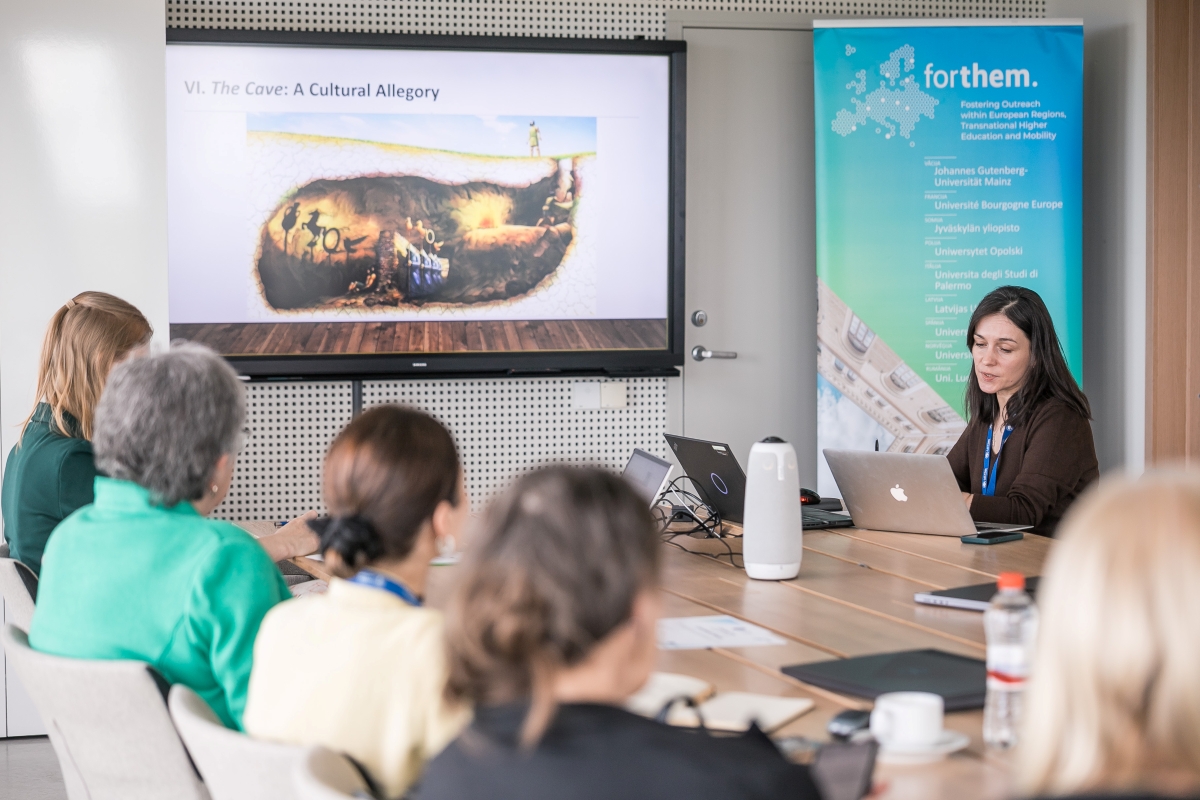
Contemporary society is saturated with images, screens and visual data, and the question of what it truly means to see is becoming increasingly relevant. Throughout the symposium visual literacy was approached not only as the ability to “read” images, but also as the capacity of engage with them reflectively generating meaning, knowledge and creative practice.
The symposium invited participants to jointly rethink concepts of seeing, bringing together not only early‑career researchers but also professors and practitioners in the humanities and the arts from different countries. This created an international academic environment for discussions on how visual literacy influences thinking, teaching, learning, research and cultural processes. The symposium was organised by the FORTHEM Laboratory for Arts and Aesthetics at the University of Latvia (UL).
Researchers from Latvia and other countries delivered papers and lectures, including Zane Ozola, Research Assistant in the Department of Philosophy and Ethics at UL’s Faculty of Humanities; UL Professor Jurģis Šķilters; and Anneli Porri, a doctoral student and junior researcher at the Estonian Academy of Arts, among others. UL doctoral student Eva Strazdiņa, who also holds a master’s degree in photojournalism, spoke about contemporary views on photorealism and visual literacy in images. Associate Professor Ritu Khanduri of the University of Texas at Arlington invited discussion on seeing cartoons and the exibiting of culture.
Aatos Ojansuu, a master’s student of Art Education at the Department of Music, Art and Culture Studies, University of Jyväskylä, spoke about literacy of Kene – the serialist graphics of the Brazilian Indigenous people Huni Kuin as a total aesthetic.
Lovela Machala Poplašen, Head of the Štampar Library at the Andrija Štampar School of Public Health, Faculty of Medicine, University of Zagreb, invited those present to discuss visual literacy in healthcare communication.
The symposium also featured creative educational workshops, such as the co‑creation workshop “Imagining Futures of Visual Literacy Education in the University”, led by Joanna Kędra, a lecturer in visual literacy at the University of Jyväskylä. UL Associate Professor Austra Avotiņa (Faculty of Education Sciences and Psychology) led the workshop “A Cultural Monument as a Dictionary of Visual Literacy”. During it, symposium participants travelled to Rundāle Palace where, together with UL students, they developed their knowledge and understanding of various aspects and methodologies of visual literacy. It was a unique opportunity, in a culturally and historically significant setting, to explore in practice and to test the ideas discussed at the symposium about seeing and visual perception.
This text was translated using AI.
