
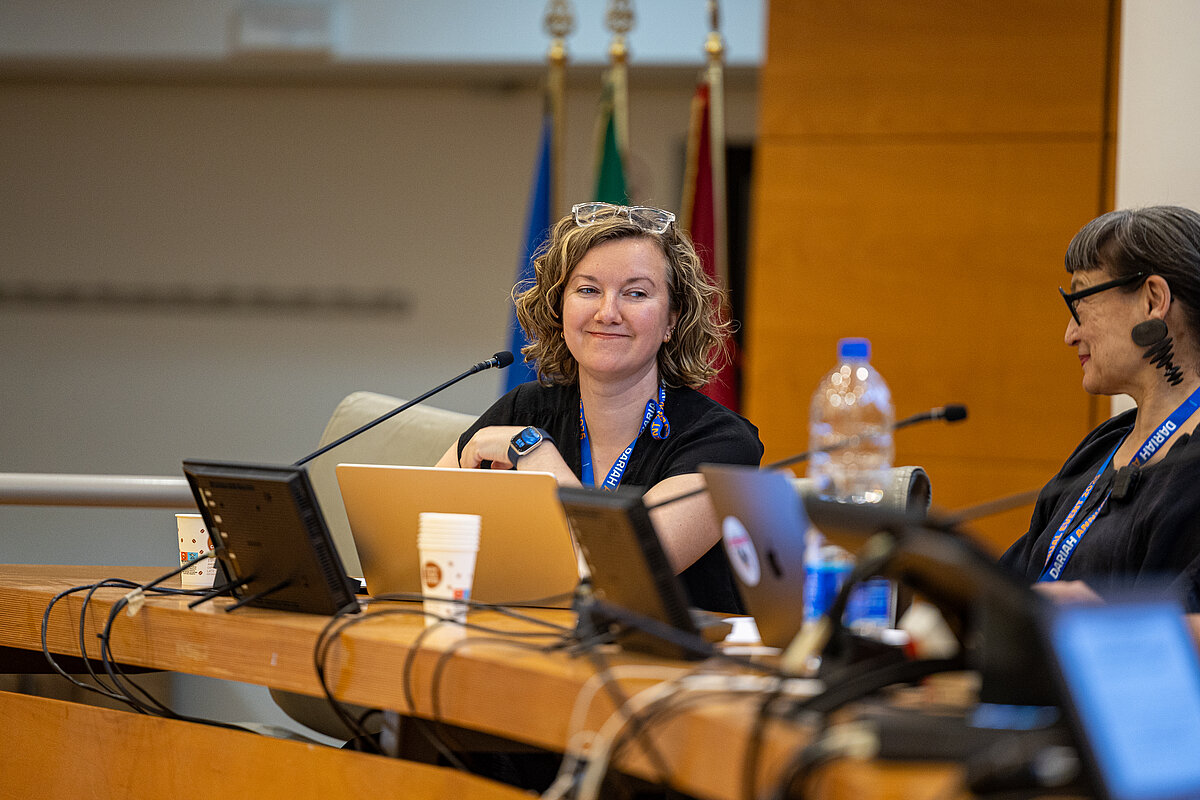
The conference focused on how digital research infrastructures, collaborative networks and humanities methods can foster public engagement, participatory knowledge creation, and sustainable cooperation between researchers, memory institutions and society.
In her address, Sanita Reinsone emphasised that digital infrastructures are not merely technical platforms for data storage, access or research. They are also long-term social relationships formed between researchers, institutions, communities and society at large. Participation, therefore, should not be seen only as data collection or short-term public engagement, but also as a matter of trust, shared responsibility, co-creation and sustainable cooperation.
From Sanita Reinsone’s perspective, a particularly critical issue is project-based funding and the capacity to develop digital humanities infrastructures beyond the framework of individual projects. The experience of recent years has shown that cultural heritage can become endangered very rapidly due to war, natural disasters, and various social or political circumstances. In such moments, public participation becomes an essential instrument for documentation, monitoring and safeguarding. This raises the question of how participation ready digital humanities infrastructures are to be used at moments when participation becomes not only desirable, but critically necessary.
This topic is closely connected to several research projects implemented by and involving the Centre for Digital Humanities at the Faculty of Humanities, University of Latvia. The University of Latvia-funded project “Open Knowledge Ecosystems for the Advancement of Citizen Science”, or ȬPEN, develops open digital solutions to expand access to language and cultural heritage resources, support their use in research, and promote public participation in the creation and circulation of knowledge.
Meanwhile, the international Erasmus+ project AISTER – AI-enabled Citizen Participation in University-driven Ukrainian Cultural Heritage Safeguarding – focuses on artificial intelligence tools and public participation for safeguarding Ukrainian cultural heritage in emergency contexts.
Latvia’s participation in DARIAH-EU is supported by the project “University of Latvia and Institutes in the European Research Area – Excellence in Research and Collaboration” (No. 1.1.1.5/3/25/I/011). The activity is coordinated by the Institute of Literature, Folklore and Art of the University of Latvia.
