
 CONFERENCE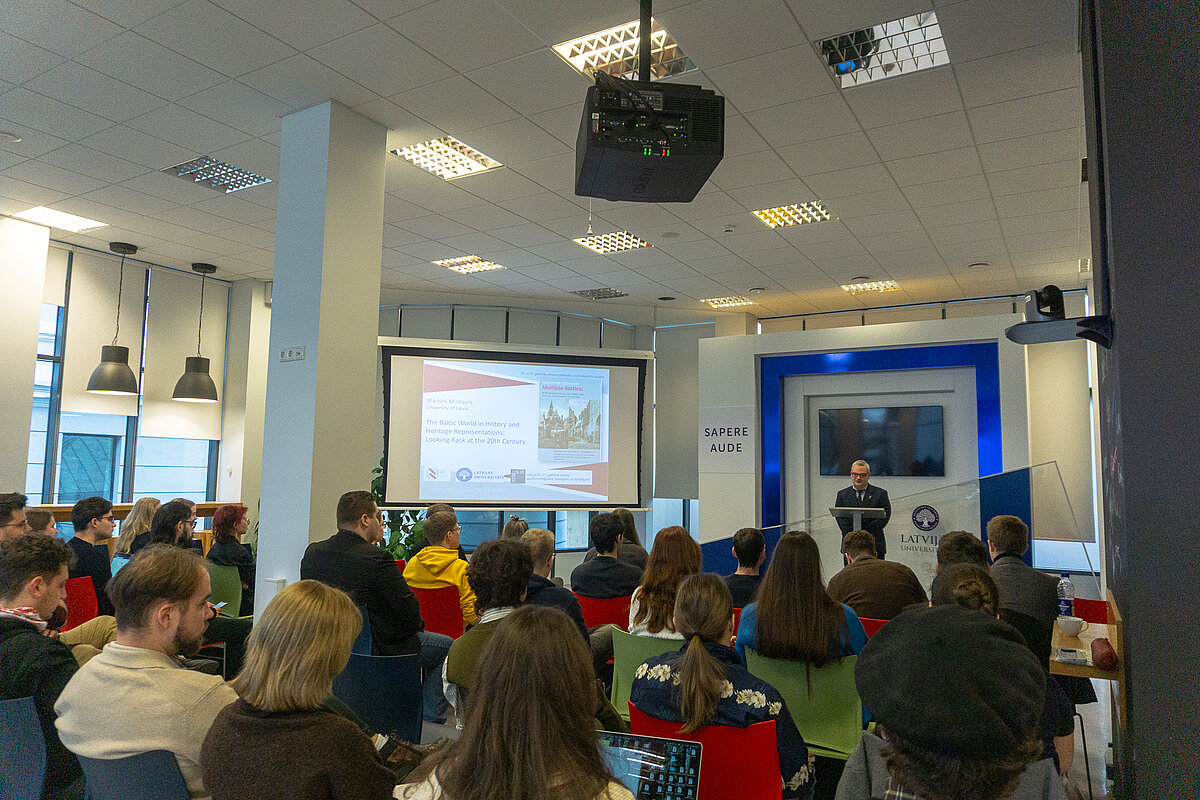


The seminar brought together around 40 students and early-career researchers from 15 countries: Latvia, Lithuania, Finland, Germany, Austria, Ireland, Spain, Italy, Croatia, Slovakia, Slovenia, Hungary, Serbia, Ukraine, and Romania. During the course of the event participants were engaged in multiple workshops, roundtables, and featured keynote lectures.
Assistant Professor and researcher Mārtiņš Mintaurs (at the Departament of History and Archeology, Faculty of Humanities, UL) highlighted the formation of conceptual framework “Baltic world” and its interplay within social, cultural and economic history frameworks in a keynote presentation “The Baltic World in History and Heritage Representations: Looking Back at the 20th Century”. The presentation was prepared with the support of the State Research project “Navigating the Latvian History of the 20th -21st Century: Social Morphogenesis, Legacy and Challenges” (VPP-IZM-Vēsture-2023/1-0003).
Associate Professor and lead researcher Gustavs Strenga (at the Latvian Academy of Culture, Institute of Arts and Cultural Studies) conceptualised reception of medieval heroes as culturally constructed phenomena “Eternal Struggles for Freedom: Long Life of the Baltic Medieval Heroes between Crusades and Nation States”, which is contextualized in-depth in the collective monograph “Doing Memory: Medieval Saints and Heroes and Their Afterlives in the Baltic Sea Region (19th–20th centuries)” (De Gruyter, 2024), which he edited and contributed.
The seminar's main concept, “Multiple Baltics,” was primarily shaped by the ideas and research projects of master’s and PhD students, offering fresh and interactive perspectives on Baltic history and fostering common knowledge production and comparative approaches through interactive workshops. The seminar’s program is structured in three parallel thematic sessions:
- Critical Cultural Heritage: Narratives, Conflicts, and Transformations in the Context of the Baltics,
- Digital History: Spatial and Social Aspects of the Baltic History,
- and a PhD workshop.
PhD student Kristina van Kuyck (Dublin City University) invited participants to critically examine monuments and memorials as texts, and to design creative strategies of re-signification that move beyond the dichotomy of demolition versus preservation in the workshop “Reading Monuments: Semiotics, Power, and Memory in the Public Space". Master’s student Elina Ziehm (Leipzig University) and Anika Olbrisch (Greiswald University) introduced with newly developed education materials created by researchers from the Critical History Tours project, funded by European Union (research consortium ISHA, EuroClio, Uncomfortable Oxford, The LIberation Route Europe (ELB), Balkan Regional Museum Network, ATRIUM) and invited participants in collaborative environment improve existing city tour or create completely new city tour at workshop “Complex Cultural Heritage in Urban Environments: Critical City Tours".
The seminar expanded participants' view on how to research digital history, which was introduced by and discussed by Haralds Matulis (PhD student and digital humanities researcher at the University of Latvia, Faculty of Humanities) in the workshop “Digital Approach in History Research – Visualization, Computational Methods, and Artificial Tools". Master students Anna Pečerska (Riga Technical University) and Elīza Dāldere (Helsinki University) discussed how to analyze spatial humanities data in the workshop "Linking Socio-cultural Data with Historical Memory in the Baltic Urban Streetscapes." PhD student Rūta Bruževica (Tallinn University), in a hands-on Transkribus workshop “Digital Livonia: a digital approach to medieval sources" explained in detail the process of training a regional medieval Livonia handwritten text recognition (HTR) model and helped participants learn beginner-level skills on the Transkribus platform. Participants examined medieval sources from the National Archives of Latvia and the Latvian State Historical Archive.
PhD workshop led by PhD student Konrad Gergely (European University Institute, Italy) and PhD student Viktória Švigárová (Pavol Jozef Šafárik University in Košice, Slovakia) united both PhD students and dedicated master level students sharing their research at any stage - starting from PhD proposal until established results of their research. In addition, during the PhD workshop, they discussed how to apply AI-powered and digital data management systems, such as Zotero, to their research.
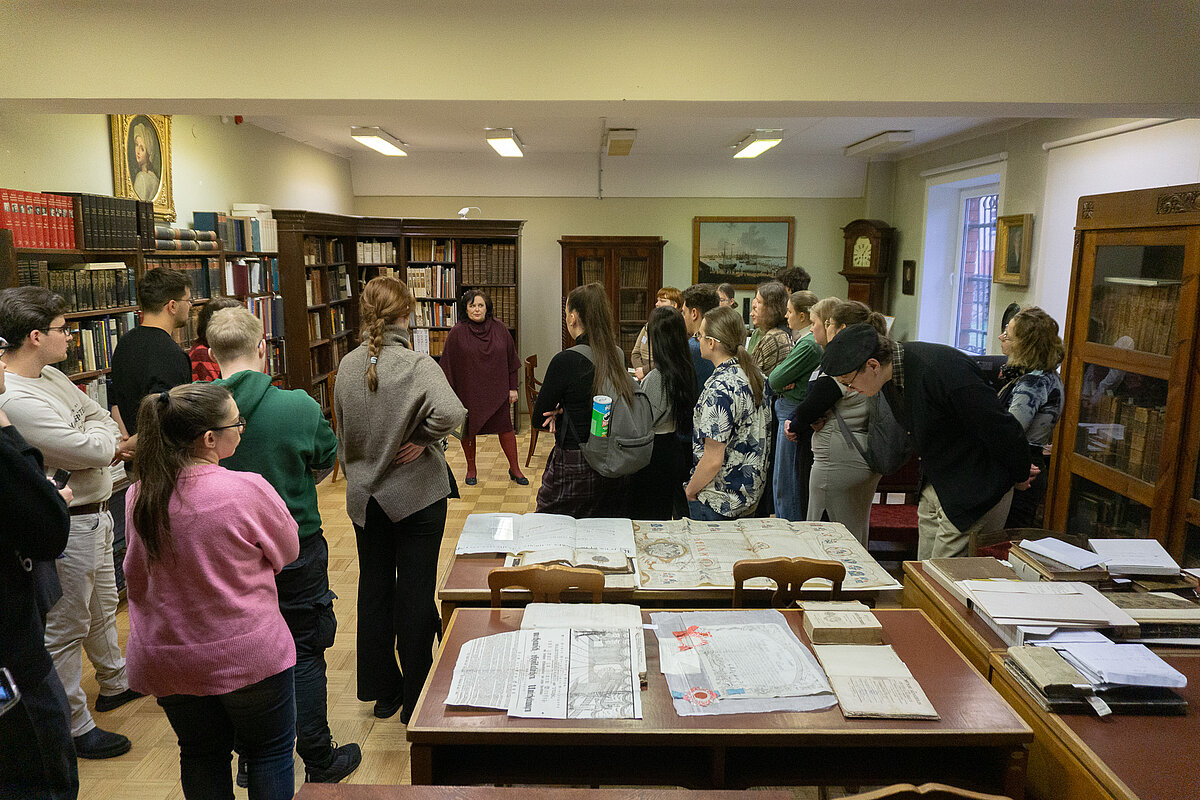
Seminar participants also engaged directly with historical sources by visiting the University of Latvia Library's collection of rare books and manuscripts, "Bibliotheca Rigensis," which is arguably the oldest collection of its kind in the Baltic Sea region, to learn about its history and research potential.
Researchers, PhD student Alise Akermane-Pokšāne and PhD student Jānis Ķimsis from the Latvian Biomedical Research and Study Centre, addressed the challenges of working in an interdisciplinary team and understanding the differences between various scientific languages in the workshop titled “Boxes, barriers and embarrassment: the not so attractive side of interdisciplinary research", bringing perspectives from history and microbiology in ancient DNA analysis in Baltic Sea region.
The ISHA Winter seminar was co-organized by the International Students of History Association (ISHA) and the Faculty of Humanities of the University of Latvia. Financial support for the event was generously provided by the Association for the Advancement of Baltic Studies (AABS) Academic Events & Projects Grant 2025/2026 and the University of Latvia Student Council (Latvijas Universitātes Studentu padome).
 Winter seminar “Multiple Baltics: Reimagining social, cultural and spatial dimensions of history” took place at the University of Latvia at Kalpaka bulvāris 4.)